.svg)
Aritma recently acquired Programekonomi, the team behind Swebase, one of Sweden's most widely used Business Central extensions.
Together, the two companies are building an end-to-end automation layer for payments, reconciliation, and bank connectivity inside Business Central.
What is Bankgirot, and what is actually changing?
Bankgirot is the payment hub shared by Sweden's major banks. It acts as an alias linked to a bank account, making it easier to send and receive payments between suppliers, customers, and individuals. It has been central to Swedish business payments for decades.
Along with it comes a set of file formats: LB format for outgoing payments, BG Max for incoming collections, and a reporting format for confirmed transactions. These formats are how most Swedish companies, large and small, move money today.
Many Bankgirot formats are phasing out in 2026. Companies that rely on these formats will need a new solution before the second half of 2026. The successor is ISO 20022 XML, the international standard already replacing legacy payment formats across the Nordics.
Most companies still handle this manually
Jörgen Hellerstedt, Senior Business Consultant at Programekonomi, points out that most companies still handle payment files manually today. They download a file from their ERP, log into internet banking, upload it, and repeat the process in reverse for bank statements.
The risks are real. Files can be altered between download and upload, reconciliation happens late, and the process depends on someone remembering to do it.
"There's a real risk in handling this manually," Hellerstedt says. "Downloading to a disk and uploading to internet banking, the risk of someone going in and changing the file is significant."
The Bankgirot phase-out creates a forcing function. Companies will need to move to a new format regardless. The question is whether they use that moment to also move away from manual file handling altogether, or just swap one manual process for another.
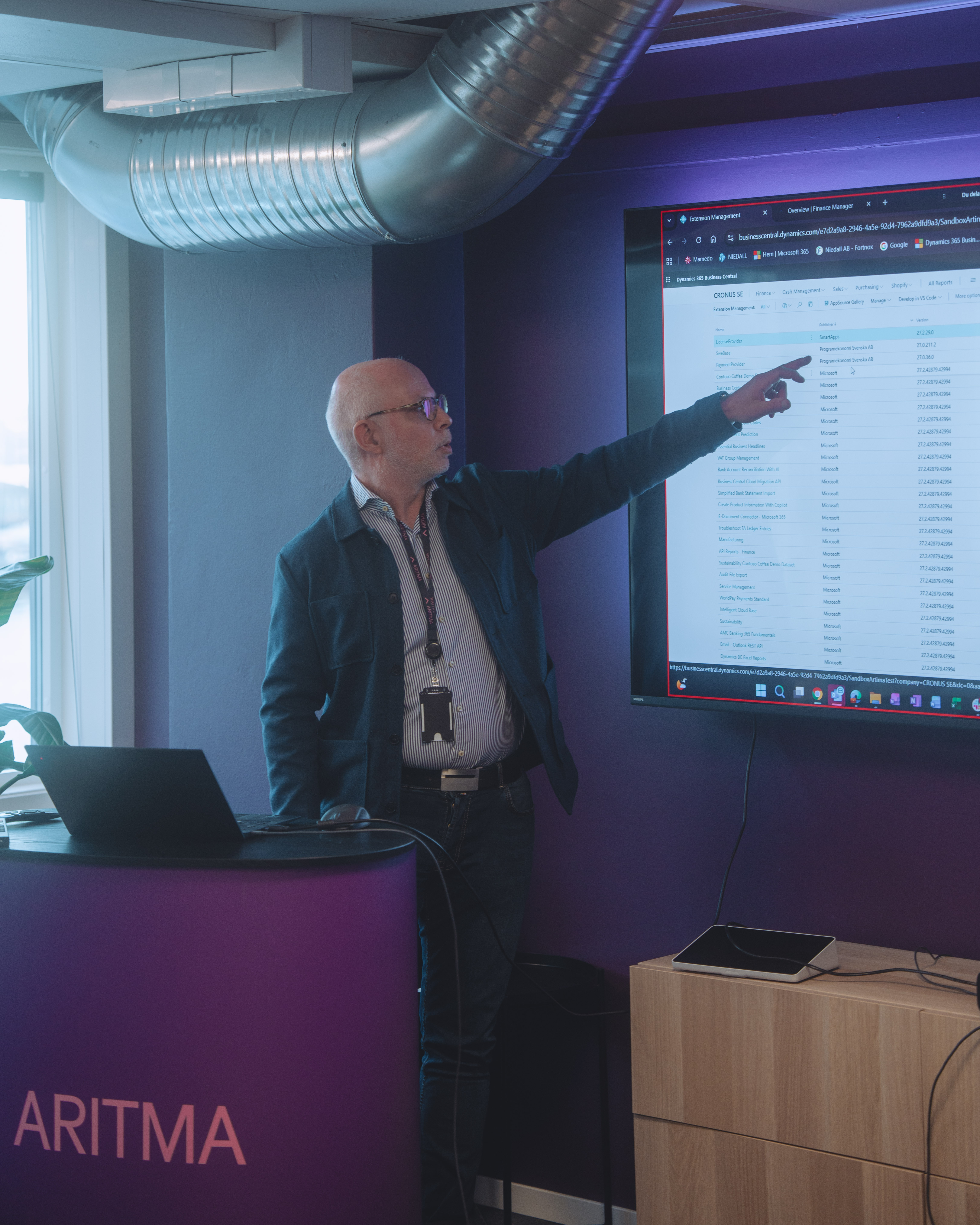
Photo: Emin Sener
Swebase: built in Sweden, used across the Nordics
Swebase is a localisation and functionality extension for Business Central. That includes bank file management, SIE integration, document handling, and compliance functions that the Business Central's standard version does not cover for Sweden.
Erngård explains what Swebase is in his own words. Watch the short clip here:
Roughly 20% of Swebase customers are outside Sweden, because Swedish parent companies with subsidiaries elsewhere want a consistent setup. The extension runs in Norway, Denmark, Finland, Germany, and across much of Europe.
The bank integration app, now shipping as part of the Swebase ecosystem, connects Swebase to Aritma's bank infrastructure and delivers fully automated payment handling out of the box.
The credit note challenge: a detail with big consequences
There is a specific technical change in the transition to ISO 20022 that many finance teams have not yet thought through.
Under the old Bankgirot system, companies could send negative payments (credit notes) and have them held in a monitoring queue. When a corresponding debit invoice arrived, the two would cancel each other out automatically. Bankgirot Centralen handled that matching.
This functionality will disappear with the Bankgirot format phase-out. ISO 20022 does not accept negative payment instructions; they will be rejected by the bank outright.
That means any company that currently relies on Bankgirot's credit note monitoring will need to handle that matching themselves before payments are sent.
Dan Erngård, Senior Business Central Developer at Programekonomi, believes that the solution to this is what he calls sam-sortering (co-sorting): transactions are sorted so that, per payment date, supplier, and currency, only positive net amounts are ever submitted. The matching happens inside the system, not at the bank.
"The credit note functionality that Bankgirot provided, we can get that back through bank functionality," Erngård explains. "But it's something every business needs to think about before they migrate."
So what’s the benefit of Business Central?
Business Central is cloud-native. Updates happen continuously and automatically, like a phone updating overnight. "When you arrive in the morning, you have the latest updates, the latest report fixes, and so on," as Hellerstedt puts it. No large upgrade projects, no half-year implementations.
It is also extensible.
The app marketplace model means you can add Swedish localisation, banking functionality, document flows, and more without touching the core system. Swebase is built on exactly this model: adding what Swedish and Nordic businesses need on top of a globally maintained platform. The integration with Excel and the broader Microsoft toolchain is a further practical advantage for finance teams day to day. And now: bank integration comes out of the box as an app.
Hellerstedt describes the fully automated flow this way:
"In practice, you won't notice when the machine is running. Everything just happens; the bank account is reconciled the same moment the reporting comes in. There's no follow-up work, no ticking off payments against your bank account. It happens automatically."
The automated payment flow inside Business Central:
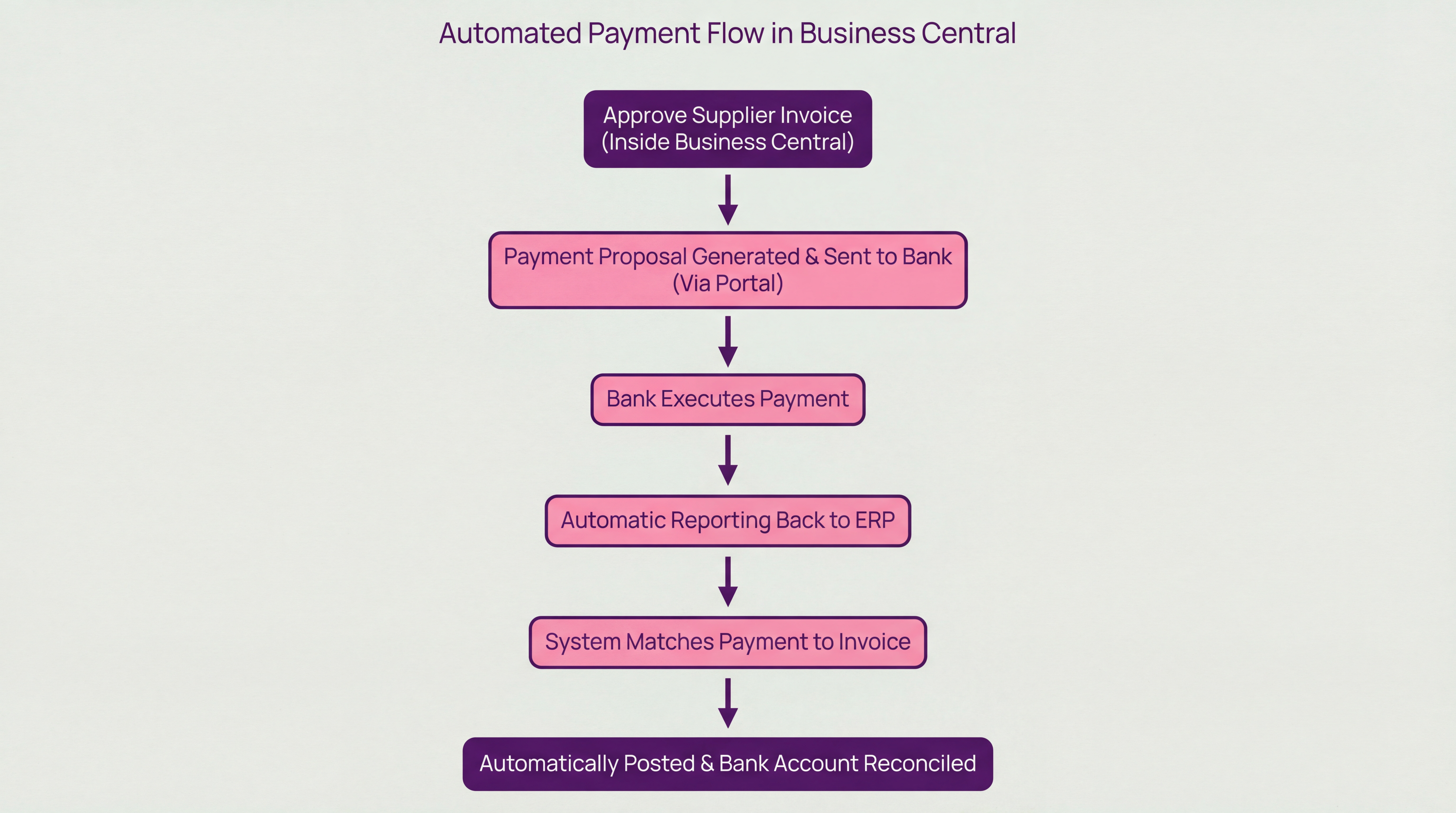
Signing payments can happen in two ways: directly inside Business Central, or in the Aritma portal. The portal is better suited to companies with more complex group structures or approval workflows.
The practical takeaway for Business Central customers in Sweden
Many Bankgirot formats are phasing out in 2026. You need a plan for ISO 20022. The sooner, the better.
Manual file handling is a risk, and this is a good moment to remove it entirely.
Swebase and the Aritma bank integrations deliver the automated, end-to-end payment flow your finance team actually wants.
Want to see how it works?
Get in touch with Aritma, we will walk you through Swebase and the bank integration in practice, and help you figure out what the right setup looks like for your business.
Key takeaways
- Many Bankgirot file formats are being discontinued in the second half of 2026. It is the formats phasing out, not Bankgirot Centralen shutting down but the effect for businesses is the same.
- Most companies still handle payment files manually today. The format change is a good moment to automate entirely.
- The credit note (negative payment) functionality from Bankgirot will not carry over to ISO 20022. Businesses need to handle matching internally before they migrate.
- Swebase solves this with co-sorting, and the new bank integration app delivers fully automated payment flows inside Business Central.
- Swebase works for Swedish companies and Nordic groups, with about 20% of customers outside Sweden.
- Bank integration is now available as an app, out of the box.